Suw Charman-Anderson, a UK self-published author and social media pioneer who also writes for Forbes occasionally, believes that Amazon is ripe for a fundamental disruption in its business model.
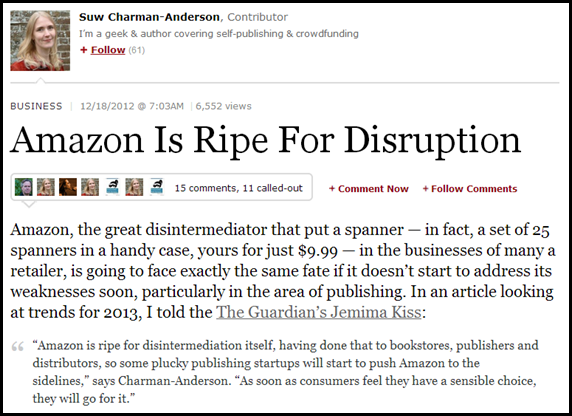
Her article – linked above – describes her argument. I’ll summarize it, briefly.
- Amazon’s review system is fundamentally broken; customers find it unreliable and sufficiently harmful to make them look elsewhere for reviews. This “will habituate them to looking outside Amazon for information on books and bring Amazon’s position as the canonical reference for books under threat.”
- Amazon’s affiliate program is not the only option, and bloggers will shift to other programs or offer multiple links. Amazon currently has share, but no competitive moat.
- Amazon doesn’t provide enough data to book publishers so they can make informed marketing decisions. Publishers cannot forge a direct relationship with their customers (and they need to).
- Publishers can’t bundle books and ebooks through Amazon.
Additionally, Suw asks:
Can Amazon be sure to maintain its dominant position purely through its catalogue, reach and discount? Is that really enough for keep it secure?
I believe there are two major problems with this viewpoint. First, Amazon’s advantages are not limited to its catalogue, reach and discount; second, that the 3 problems Amazon has are disruptive.
Conceiving of Amazon as an online version of WalMart (or ASDA) is a mistake. The core operating principle of Amazon – that I can see – is to lower the friction of each marginal purchase. Once you have an account on Amazon, each additional order becomes easier. If you buy enough things (say, one purchase a month) where an Amazon Prime subscription pays off, the friction lowers even more. And if you buy a Kindle, the friction for certain media drops further still – down to instant gratification.
This is one of the reasons why Amazon has so strenuously defended its 1-Click patent: it regards the ease of purchase as a serious competitive advantage.
And, while Amazon doesn’t kick data back to its suppliers, it uses every scrap of data it can get its hands on. If you have an Amazon account, and you visit Amazon to check out a product, Amazon will note that and then email you later with an offer. The time delay of the email, and the quantity of the emails, is – I’m confident guessing – variable on a per-person basis to maximize read-and-clickthrough rate. This is one of the smallest things Amazon does.
In fact, I wouldn’t be surprised if the industry upset over how Amazon has been managing reviews has to do with Amazon choosing what reviews to feature / hide / etc based on how that maximizes conversion rates and minimizes returns. What seems to be random deletions and arbitrary rules is more likely to be Amazon being very aggressive about managing KPIs for conversion rates and customer satisfaction.
The combination of Amazon’s near-obsessive focus on making marginal purchase decisions easy – i.e. their conversion rate – and their well-known focus on using data to make decisions means that Amazon does have a sustainable competitive advantage with their affiliate system.
An independent website, seeking to monetize links to a retailer, will base their opinion on one primary thing: what makes them the most money. I would wager that the conversion rate from Amazon Affiliate links is much higher than the conversion rate from other links.
Which means that (i) Amazon is likely the preferred affiliate link, and (ii) adding more affiliate links on a page will lead to a net decrease in revenue (if for no other reason that multiple links for the same thing decrease total clickthrough rate – the cognitive load of making a decision about which link to click on is more than most people care to exert).
Unfortunately, I also don’t find Suw’s criticism of Amazon’s poor data-sharing habits. Oh, not that the data Amazon makes available is good – it’s not, if you want to have good ROI numbers for your marketing work – but publishers don’t care. They may complain about it – but for their entire existence, book publishers have sold through multiple channels. No brick and mortar bookstore kicks back sufficiently detailed information to know if customers purchased a book based on a TV ad, a Facebook ad, or a news article. I doubt they collect it themselves.
Publishers, in other words, are not facing anything new.
I imagine that’s why Suw’s solution is not for publishers to exert themselves such that Amazon sees the error of its ways.
No: Suw’s solution is more radical.
Think about this: These days, authors have to do a lot of their own promotional work. Contrary to popular belief, just chucking a book on Amazon doesn’t mean that it’s going to get found and bought. And that’s especially true for new entrants with no reviews, no or low sales, and a price below £2.49. You have to promote, and promote hard. Doesn’t matter if you’re self-published or an author with a traditional publishing house, at some point you have to reach out to your audience and say, “Here is where to buy my stuff”.
That means you can choose where to send them. Will you link to Amazon, where your sale goes into a data black hole, or will you send them to your own webshop, or your publisher’s, where that information can be captured and you can provide a few little extras to keep your readers sweet?
Why is this wrong? Because it’s all about the sales.
Fundamentally, people – publishers or authors – can use detailed data to maximize profit. There are two ways to do this: increase revenue, or decrease costs. More detailed data allows them to spend marketing dollars where they have the highest ROI (increasing revenue), and it also allows them to identify losses more quickly – cutting off spend.
But sales data does most of that. And, because book publishers have diversified sales channels, they can get a pretty good idea of what advertising channel has higher ROIs. They get rough geography, research reports can give them broad demographics (who shops where), etc.
Could they use more data? Sure, everyone could. They could, for example, use it to identify customers who are most likely in a new book, and send them personalized emails.
Except Amazon does that already.
What’s the real benefit in doing that kind of personalized marketing work yourself, if your retail partners do it for your? You’re taking on extra cost, and unless you somehow extract more money from the chain – e.g., charging higher prices – it’s not worthwhile.
It might make sense, of course, if your retail partners aren’t doing any of that marketing work. Thus, it makes sense to advocate for publishers to do a lot of that if you also want them to replace their retail partners:
Suw explains:
I don’t know how much more information a major publisher gets out of Amazon, though I’m guessing it isn’t half as much as they’d get if they ran their own retail operations. And ecommerce is a problem that has been solved. There are plenty of off-the shelf-solutions for inventory tracking, sales, fulfilment (both digital and physical), the whole nine yards. There’s absolutely no innovation needed for publishers to start their own retail outlets online. They could get going tomorrow if they so chose.
Apart from significantly underestimating the costs for running an ecommerce website, I’m not sure Suw understands that she’s making an argument for vertical integration (or that many publishers used to offer purchases through their own website, and some still do).
It would be a significant industry shift. A publisher makes money by (i) identifying excellent books, and then (ii) selling those books everywhere they can. They only need a fraction of the books they select to be really successful, and they can lose money on the others (no judgment is going to be perfect). They can incentivize authors to publish with them by offering marketing campaigns, editing services, etc to improve the quality of the product. They can sign long-term deals (multiple years, books) in recognition that there are non-trivial setup costs for a name-brand author that will sell via name alone.
It’s an entirely different arrangement from classic retail stores, who try to (i) identify great books after they are ready, and then (ii) make it easy to buy them.
Indeed, you could argue – as Suw does – that “Amazon now risks exactly the same disintermediation that it perpetrated a decade ago.” Amazon would be ‘disintermediated’ from the sales process.
Unfortunately, I don’t think Amazon did disintermediate anyone. Rather, Amazon disrupted the cost structure of traditional retail.
| Tradition Brick & Mortar |
Amazon |
- Print book
- Store at Warehouse
- Ship to Store
- Customer Shop at Store
|
- Print Book
- Store at Warehouse
- Customer shops at website
- Ship to Customer
|
There are two things to note: first, that a website has high upfront costs but low marginal costs with tiny increments. There’s a reason that Amazon was founded in 1994 and turned its first profit over 7 years later.
In contrast, brick and mortar stores face a step function for growth. To open a new market, they need to create a new store which is a non-trivial expense. Additionally, their market was bounded by the geographic area within which people are comfortable travelling. Nor are stores cheap to maintain.
You can buy from Amazon nearly anywhere. Not so with Barnes & Noble, Waterstones, etc.
Second, that Amazon faces lower risk in carrying a title. Amazon ships a book out only after a customer pays for shipping costs; a brick & mortar store pays to bring the book to the store, first. Since Amazon can ship from any warehouse, it has less duplication.
This means that Amazon can also offer a far larger catalog, and then limit what it presents to people based on sales. A traditional bookstore can only have a limited supply of books in stock.
The disruption was away from having a physical store – a significant capital investment, both in real estate and inventory – and towards a virtual store, which doesn’t operate with the same limitations.
Suw suggests no disruption in either cost or limitations, just a shifting of the existing cost structure – vertical integration, in other words. However, there’s no real reason to expect that a vertically integrated publisher would do better.
Of course, Suw could be right. Some retailers have publishing arms – Barnes & Nobles owns Sterling Publishing Co; Amazon has Kindle Direct Publish, as well as a string of publishing brands (47North, AmazonCrossing, AmazonEncore, Thomas & Mercer, Montlake Romance, and Amazon’s Children Publishing). But those don’t seem to be to be major players – despite Sterling Publishing being around since 1949 (although Amazon Direct Publish could be …bad… for publishers, long-term. That’s a serious disruption play: publish first, then filter later. Publishers operate as gatekeepers; Amazon gets rid of the gatekeeper, just hides books that don’t sell).
Suw Charman-Anderson has not, in my mind, predicted any market disruption. Worse, I think that the weaknesses Suw identified is more nitpicking than necessarily weaknesses – and even if they were, I see no reason why Amazon could not eliminate those weaknesses with a relatively minor effort. There’s nothing stopping Amazon from “solving” any of the issues Suw brings up except that Amazon doesn’t want to. Is its reasoning correct? Perhaps not – but when Amazon is operating by choice, and not an exogenous limitation, the possibility of disruption is slim indeed.