Mercenary Armies are Scary

Newsweek reports:

Blackwater is Soaked

Oct. 15, 2007 issue – The colonel was furious. “Can you believe it? They actually drew their weapons on U.S. soldiers.” He was describing a 2006 car accident, in which an SUV full of Blackwater operatives had crashed into a U.S. Army Humvee on a street in Baghdad’s Green Zone….

I find the fact that the US government is using private companies to wage war – mercenary armies validated by US law – terrifying. The Pentagon outsources roughly half its budget, and it’s still trending upwards.

It seems like little more than a flimsy excuse to sidestep judicial oversight and public accountability. The government has certain duties to the people, and other nations; private companies do not. I suppose it’s simply an advance on the concept of “plausible deniability.” Perhaps more concerning – it’s the “military-industrial complex” brought to life. When you spend a few hundred billion a year, companies spring up to happily take some of it. They then have money to finance a lobbying organization to expand or maintain the amount spent on their industry.

Given some of the accusations leveled at Blackwater – a for-profit organization that seems to ignore both the spirit and the letter of the law when they think they can get away with it, not to mention general incompetence – I’m not comfortable letting Blackwater and similar organizations run amock.

I would prefer to live in a country where I can trust the government. Or, at the very least, where the government is intrinsically harmless.

Right now, neo-conservatives seem to be obsessed with making a minority of hangers-on and yes-men rich, at the expense of America. We are establishing organizations with a direct incentive to reduce American liberties, commit moral atrocities, lie, and steal from the public. As anyone whose taken Microeconomics – or psychology – knows, people respond to incentives.

That’s not pleasant to consider.

Social Interaction and the Internet

It’s interesting to observe that for all the friends we accumulate over a lifetime, the way we go about getting them is terribly inefficient.

I’m guessing that most people meet friends at events they both attend – at school, it’s a class or a party. At work, it’s, well, they office or the pub.

Consider how improbable it is that two people attending the same event will (1) meet and (2) have enough in common to become friends. Or that two people who could be friends (1) decide to go to the same event, (2) meet, and (3) eventually become friends.

Sure, we filter out some people. For instance, people tend to approach people who ‘look’ like them – wear the same types of clothes and so on. Then, they stay with people who speak like them – slang, jargon, etc. But that in itself is pretty misleading – how many interesting people are you filtering out? I can’t see how wearing different clothes makes you any less worth knowing.

I’m going to guess that it’s pretty unlikely. I’m going to assume that the ‘natural’ way of making friends, dating, and generally finding interesting people is pretty inefficient.

So what does that mean? First of all, that people, by and large, aren’t very picky when it comes to whom they’re friends with. We can guess that when making friends, the degree of ‘compatibility’ (it’s a terrible word, but I don’t have a better one) determines the ‘quality’ of the friendship.

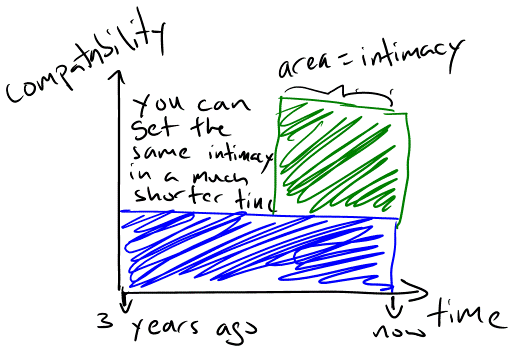
In pure speculation, I’m guessing that if you’re highly compatible with someone, you can establish a high degree of intimacy with someone after just a short time. (That guy sooo understands me, in valley girl-esque speak). I’m further going to guess that you can establish a similar level of intimacy with someone less compatible, but it’s going to take more time – for those who still remember Calculus, it’s a basic integral.

I’ve drawn a small diagram to illustrate the concept. If intimacy is the integral of compatibility between two people and time spent together, then it’s easy to see how you get a similar level of intimacy in a much short time. Of course, it also depends on what ‘type’ of relationship you have – someone you’re dating heavily is much more likely to get their faster than they guy you have a couple beers with after work.

So we can guess that there’s a lot of room to improve how people become friends.

I think that the internet is going to play a pretty big part of that. Currently, there’s no competition. We have the pathetic little dating sites – True, Match.com, Tickle.com, etc. But they’re focused on dating, and their ‘tests’ are quaint but not much more (besides, how many people are honestly going to fill out a few hundred questions just for the sake of meeting a few people?). Social networks are interesting, and enable finding people with similar interests through tag-based interest-fields. Nothing’s going to happen soon.

I’m still keeping an eye on social networks and dating sites to see how fast what’s developing.